


Old Kardamyli is the village’s memory. Above the lower village’s square, harbour and tavernas, the old settlement climbs a spur of the hills: stone tower houses, narrow lanes, and the fortified Troupakis-Mourtzinos complex with its 18th-century church. It is the best short outing near the cottage: an uphill walk, a small entry fee, and centuries of Maniot history.

The church of Agios Spyridon among the stone houses of Old Kardamyli. Photo: Harald Rossa, CC BY-SA 3.0, via Wikimedia Commons.
What Old Kardamyli is
Kardamyli has two faces. The lower village around the square, the harbour and the beach is where daily life happens. Above it sits the older settlement, Pano (upper) Kardamyli: a fortified cluster of tower houses built by powerful families, the kapetanioi, the local landlords who for long stretches of history answered to no outside authority. In the Mani, a tower measured a family’s standing.
The dominant family here was the Troupakis-Mourtzinos clan, counted among the most powerful in the Mani in 17th-century records. Their walled compound took shape over two centuries, from the 1600s to the 1800s, and the main tower dates to 1807. In the late 1960s the family’s heirs transferred the complex to the Greek state on the condition that it become a museum. It now operates as a state museum, with a permanent exhibition on the Mani.
The church of Agios Spyridon
The first building you meet inside the gate is the church of Agios Spyridon, the clan’s private church. Built in the 18th century, and dated on stylistic grounds to the second Venetian occupation of the region (1685-1715), it is a single-aisled, barrel-vaulted domed basilica of rubble masonry, with massive poros stone blocks on the south side. The entrance door and windows carry sculpted decoration, and parts of the masonry reuse older ancient and Byzantine material. The tall bell tower, decorated with low-relief motifs in a western pattern, and the two-headed eagle over the entrance show how far the family’s wealth and contacts reached. Local lore holds that the church bell was once pirate loot.

The church of Agios Spyridon, built for the Troupakis-Mourtzinos family in the 18th century. Photo: Almpanis Evangelos, CC BY-SA 4.0, via Wikimedia Commons.
It was never a parish church. It served the family alone, and after the last descendants it was left to decay until a restoration some years ago. It still opens only on the patron saint’s day, December 12, and for special occasions such as baptisms and weddings. Go for the exterior, the sculpted stonework, and the way it anchors the whole complex. See the Messinia tourism portal’s entry on the church for more detail.
Inside the Mourtzinos complex
The compound reads as a small self-sufficient town. The arched gate, half-demolished but still standing, opens onto the church. The base of the tower once served as a prison, and the main tower itself could only be entered by a wooden bridge that could be lifted. The climbable upper floors give views over the old settlement and the coast. A Greek travel feature on the tower tells the family’s story in full.
The tower and the museum
The main tower dates to 1807, though the complex’s buildings rose gradually from the 17th to the 19th century. The three-storey oda residence now holds the museum’s permanent exhibition: maps, engravings, photographs and drawings with accompanying texts in Greek and English, telling the story of the Mani. Notice boards around the site explain what each building was for, and the whole complex is treated as an exhibit in itself.
The Kolokotronis connection
In early 1821, after returning from Zakynthos, Theodoros Kolokotronis stayed in the complex for about two months. From here, local accounts hold, he and other Maniot leaders planned the move on Kalamata. The family played its part in the revolution: one of its sons, Dionysios, who died in 1830, belonged to the Filiki Eteria, the secret society working toward the uprising.
A self-sufficient household
The walls held olive presses and vegetable gardens. The compound fed itself and made its own oil without leaving the fortifications, a blend of defense, production and worship. In a region where olives have long been central to daily life, the presses show how a powerful household provisioned itself in both peace and war.
The family
The Troupakis-Mourtzinos were among the Mani’s most powerful families in the 1600s, and their recorded ancestor is Michael Palaiologos. In the late 1960s the heirs, Maria and Eleni Boukouvalea, transferred the complex to the Greek state to become a museum.
Check entry and hours on the day. Recent visitors report a fee of around €5 for the museum buildings, and opening days and hours vary by season. Late afternoon is the favourite time for the walk: the low sun hits the stonework, and you can stroll back down to the lower village for the evening.
Beyond the walls
Two more stops sit outside the complex walls, each adding a layer to the area’s very long history.
The Dioscuri tombs
Above the old settlement, twin rock-cut chambers are traditionally linked to Castor and Pollux, the Dioscuri of Greek myth, following the description of the ancient geographer Strabo. Archaeologists date the two-chamber tomb to the Hellenistic period, the 3rd to 2nd century BC. Reach it on foot from Old Kardamyli along the path toward Agia Sophia, about a ten-minute walk. The tomb is a listed monument and entry to the interior is not allowed. See the Messinia tourism portal’s entry on the tombs.
The Leigh Fermor connection
Kardamyli owes much of its fame to the travel writer Patrick Leigh Fermor, whose book Mani (1958) drew the world’s attention to the peninsula. In 1964 he bought land in a bay south of the village and built the house where he and his wife Joan lived for the rest of their lives. He left the house to the Benaki Museum, which runs it as a writer’s residence with guided tours and cultural programmes. It sits by the shore, not in the old town, and visits are arranged through the museum.

Old stonework on the lanes of Kardamyli. Photo: Ziegler175, CC BY-SA 3.0, via Wikimedia Commons.
Planning your visit
The old town is an easy outing, not a day trip. It suits any day you want history with very little driving: park in the village and walk up from the main street. From the main street, opposite the two supermarkets, look for the road sign for Kardamyli Old Town: the walk up is about ten minutes, uphill, through the lanes.
The Mourtzinos complex in Old Kardamyli, Messenia. Map: OpenStreetMap contributors.
Where to stay
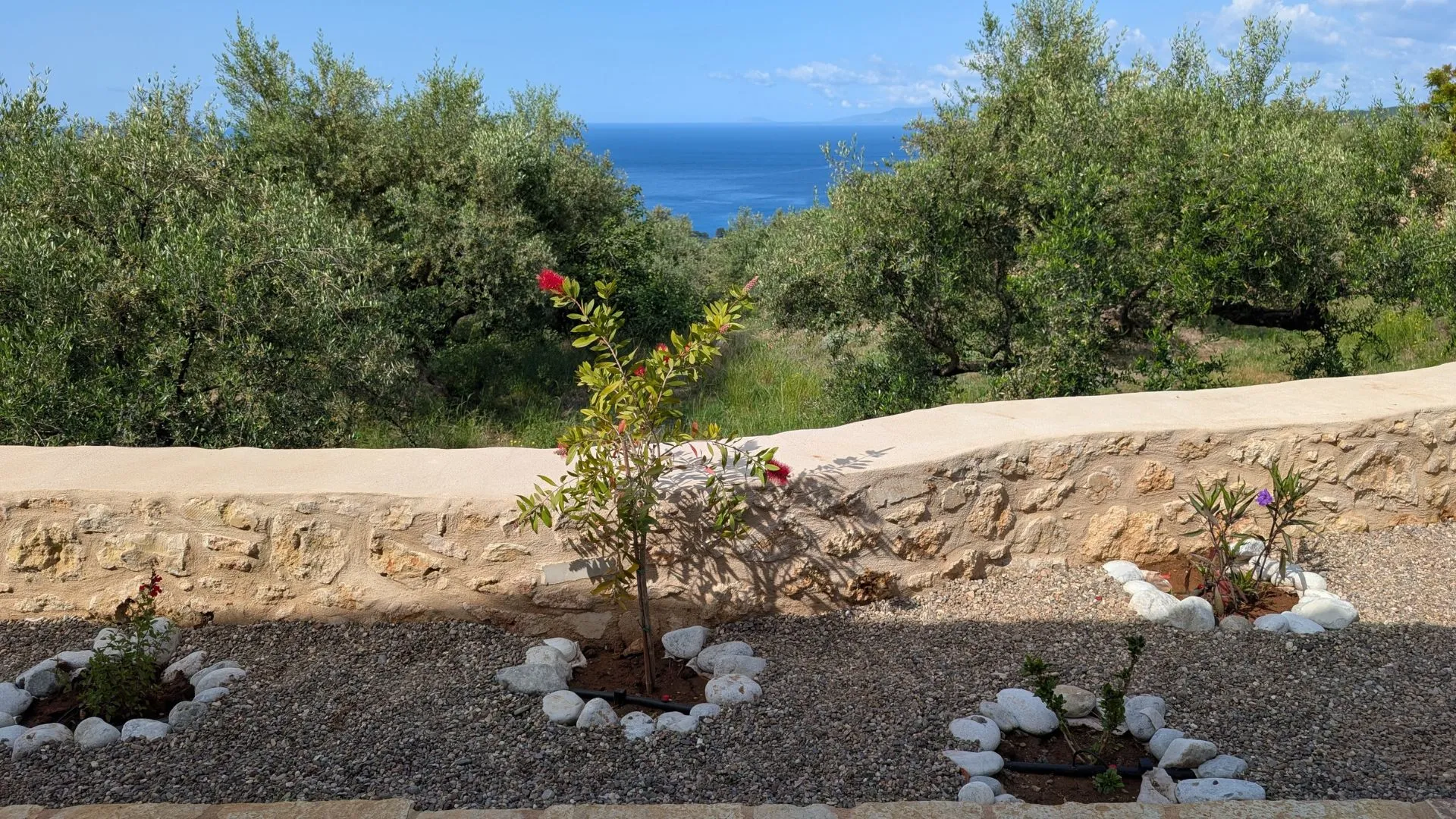
Achilles Cottage sits in the hills above Kardamyli, a couple of minutes’ drive from the old town: two bedrooms sleeping four, a full kitchen for an early breakfast, and a walled garden and terrace to come back to. The cottage’s standard minimum stay is 5 nights. Note that Achilles Cottage has no pool, and cottage guests do not have access to the Main Villa pool. See the full cottage details for the layout.
How to book a stay near the old town
- Book direct on achillescottage.com. Use the live calendar on the booking page to check dates and confirm. The cottage’s standard minimum stay is 5 nights. Guests who confirm within 24 hours of their inquiry may be eligible for a 10% courtesy discount.
- Also listed on Airbnb, Booking.com, and Vrbo.
Frequently asked questions
How do we get to Old Kardamyli from the cottage?
Drive the couple of minutes into the village and park, as the road from the cottage is busy and has no pavement. From the square, the old settlement is about a ten-minute uphill walk through the lanes. It is an uphill stroll rather than a flat one, which is why many guests pair it with the late afternoon rather than midday.
Is the Mourtzinos complex a museum?
Yes. The Troupakis-Mourtzinos fortified complex is a state museum, with a permanent exhibition on the Mani inside the three-storey oda residence. Recent visitors report an entry fee of around 5 euros; opening days and hours vary by season, so check before you go.
Can you go inside the church of Agios Spyridon?
Not usually. The restored church opens only on the patron saint’s day, December 12, and for special occasions such as baptisms and weddings. Visit for the exterior, the sculpted bell tower, and the setting inside the old fortifications.
What are the Dioscuri tombs?
Twin rock-cut chambers above the old settlement, dated to the Hellenistic period (3rd to 2nd century BC) and traditionally linked to Castor and Pollux, the Dioscuri of Greek myth. They are about a ten-minute walk from Old Kardamyli along the path toward Agia Sophia; entry to the interior is not allowed.
Does Achilles Cottage have a pool?
No. Achilles Cottage has no pool, and cottage guests do not have access to the Main Villa pool. After the walk uphill, the walled garden and terrace are the place to recover.
Photography: Harald Rossa (CC BY-SA 3.0), Almpanis Evangelos (CC BY-SA 4.0) and Ziegler175 (CC BY-SA 3.0), all via Wikimedia Commons.
Explore the old town, then come home
Achilles Cottage puts you a couple of minutes’ drive from Old Kardamyli’s towers and churches, with a quiet garden to return to. Check availability for your dates.